
Elvis Presley's first appearance on the Louisiana Hayride on Oct. 16, 1954, helped put an emerging sound before a wider radio audience. The Shreveport, Louisiana, program gave the young singer a platform as he developed the blend of musical styles that would help transform popular music. It stands among the most consequential events associated with this date, alongside Little Richard's recording debut and a hometown celebration of Chuck Berry.
Get The Latest News!
Don't miss our top stories and need-to-know news everyday in your inbox.
The story begins three years earlier. On Oct. 16, 1951, 18-year-old Richard Penniman, already performing as Little Richard, made his first recordings in Atlanta. The session took place at radio station WGST, with musicians from singer Billy Wright's backing band. Wright had introduced Richard to disc jockey Zenas Sears, providing a connection that helped the young performer enter the recording business.
This was not yet the Little Richard familiar from his breakthrough rock 'n' roll records. He was still working in the shadow of Wright's vocal style. Material from this and a later session appeared in early 1952, including the blues ballad “Every Hour,” which found local success in Atlanta and Richard's hometown of Macon, Georgia. The importance of the date lies in that beginning: A future musical innovator was learning how to turn his stage ambitions into records. His national breakthrough came later, after he joined Specialty Records and released “Tutti Frutti” in 1955.
On Oct. 16, 1954, Presley stepped onto the stage at Shreveport's Municipal Auditorium for his Louisiana Hayride debut. He was 19. The program had built a reputation for introducing promising performers rather than simply showcasing established stars, making it an important opportunity for an artist still developing his audience.
Presley performed “That's All Right” and “Blue Moon of Kentucky,” the contrasting songs that defined his early recording identity. The surviving recording preserves a performer near the beginning of his career, before his name became synonymous with international stardom. His successful appearance led to a Hayride contract dated Nov. 6, 1954. That distinction matters: Oct. 16 was the debut, not the contract signing. The relationship gave Presley a continuing place on an established broadcast, helping turn an initial appearance into a sustained opportunity to reach listeners and sharpen his performance.
On Oct. 16, 1965, the Beatles recorded “Day Tripper” at EMI Studios in London, with George Martin producing. Written by John Lennon and Paul McCartney, the song emerged during the sessions for “Rubber Soul,” but its initial destination was a single rather than that album. The recording became one half of a release that gave listeners two featured songs instead of a conventional lead track and supporting flip side.
“Day Tripper” arrived in Britain on Dec. 3, paired with “We Can Work It Out” as a double A-side. The pairing topped the British singles chart, while “Day Tripper” reached No. 5 on the Billboard Hot 100 in January 1966. Those later results distinguish the October studio milestone from its commercial aftermath. The session captured the Beatles balancing their identity as a rock band with the expanding musical ambitions of the “Rubber Soul” period, while still making recordings designed to stand on their own as singles.
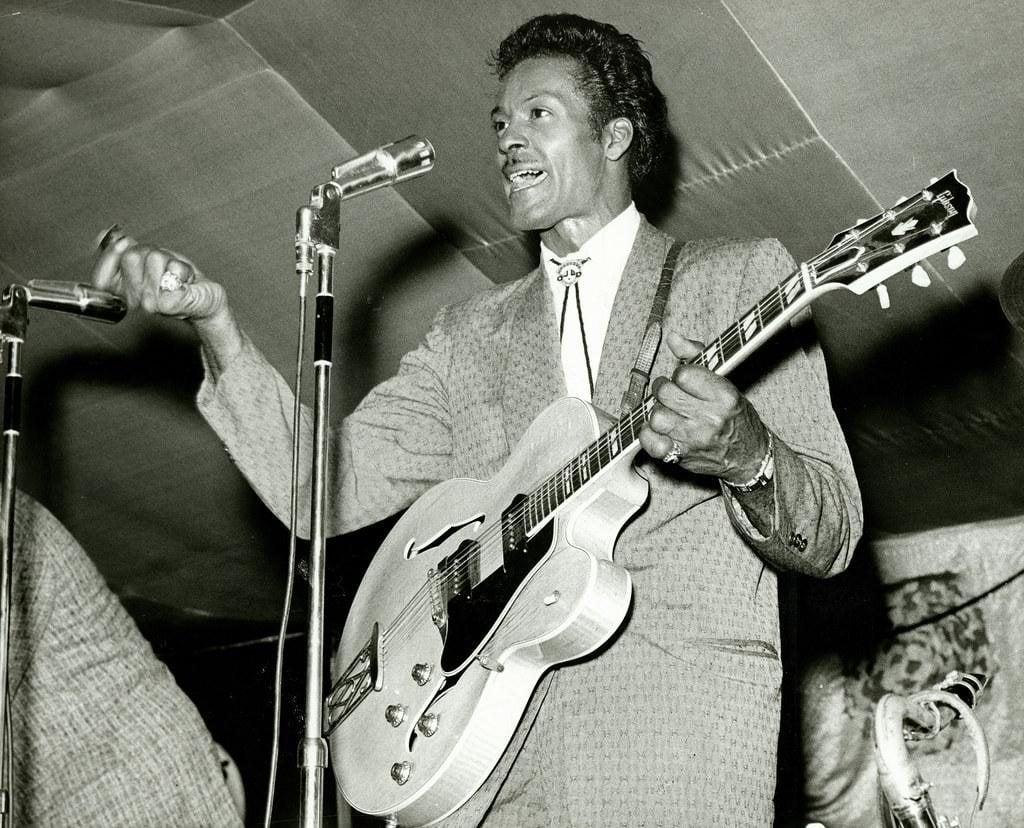
The date has a direct St. Louis connection in 1986. On Oct. 16, Chuck Berry performed at the Fox Theatre in concerts organized by Keith Richards to celebrate Berry's 60th birthday. The celebration preceded the actual birthday, Oct. 18. It brought Berry together with musicians whose participation made the evening a tribute across generations.
The lineup included pianist Johnnie Johnson, while guests included Eric Clapton, Robert Cray, Etta James and Linda Ronstadt. Performances ranged across Berry's catalog, including “Roll Over Beethoven,” “Memphis, Tennessee” and “Brown Eyed Handsome Man.” The concerts became central to the documentary “Hail! Hail! Rock 'n' Roll.” For St. Louis, the occasion was more than a celebrity gathering: It placed Berry's music at the center of a major filmed celebration in the city associated with his career, with younger performers sharing the stage rather than merely describing his influence.
On Oct. 16, 1992, another gathering demonstrated how widely one songwriter's work could travel. Musicians assembled at New York's Madison Square Garden to celebrate Bob Dylan's 30 years as a recording artist. The four-hour concert, broadcast internationally, brought together performers from rock, folk, country and soul. Neil Young dubbed the occasion “Bobfest.”
The selections showed the breadth of Dylan's catalog. Stevie Wonder performed “Blowin' in the Wind,” Johnny Cash and June Carter Cash sang “It Ain't Me Babe,” and Eddie Vedder and Mike McCready performed “Masters of War.” Dylan joined Roger McGuinn, Tom Petty, Young, Clapton and George Harrison for “My Back Pages.” Like the Berry celebration six years earlier, the concert made musical influence audible: Different voices and traditions found room inside the same body of songs, demonstrating that a songwriter's legacy could keep growing through other musicians' interpretations.
Send your news tips to news@edglentoday.com or on twitter @EdGlenTodayNews


